

For 25 years, ecommerce has been built around one assumption: a human is doing the shopping. Search results, product pages, recommendations, reviews, carts and checkout all assume someone is looking at a screen and moving through a sequence:
Search → Product Page → Reviews → Cart → Checkout
Even the first wave of AI shopping didn't change this architecture. It put conversational interfaces in front of systems still designed for humans. Alexa shopping wasn't agentic commerce. Voice and NLP changed the interface. The human still drove the transaction.
That is changing in a big way. Personal agents from Meta, OpenAI, Google and others are putting software in charge of the purchase.
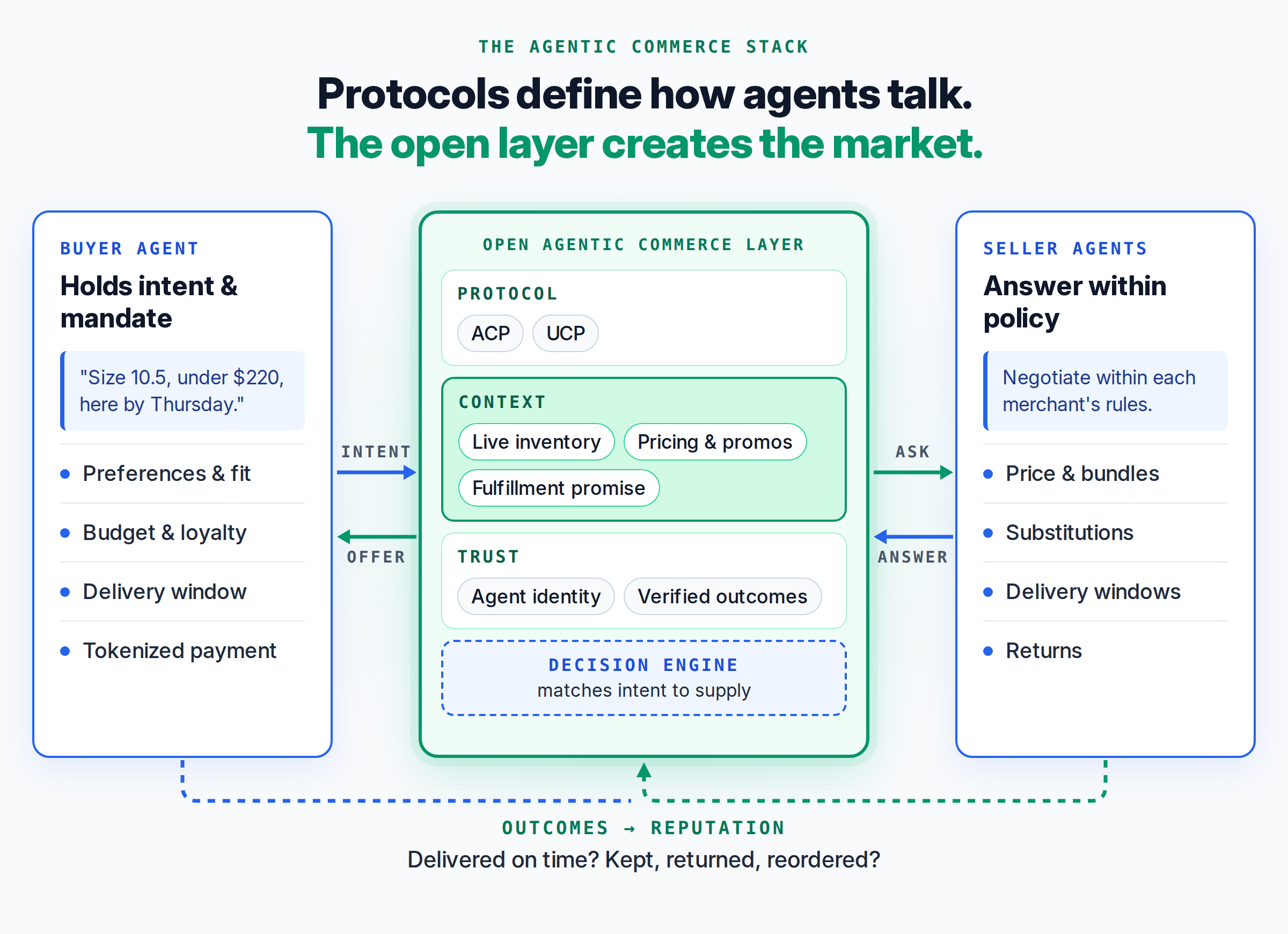
But a buyer agent alone doesn't create agentic commerce. The seller side has to become agentic too. Between them, a new commerce layer is needed to exchange intent, context, trust, and transactions.
Buyer Agent ⟺ Open Agentic Commerce Layer ⟺ Seller Agent
Once software represents both sides of the transaction, the retail stack has to be rebuilt around it.
The Click Gives Way to Intent
Today I search for running shoes, open several tabs, compare specs, read reviews, check delivery dates and eventually decide.
An agent skips that journey. I say: "Get me carbon-plated marathon shoes in size 10.5 under $220, delivered before Thursday. Use my loyalty rewards."
My agent already knows my size, preferences, purchase history, budget, loyalty programs, payment credentials and delivery requirements. Discovery, comparison, payment, tracking, returns and replenishment all happen underneath that one intent.
The fundamental unit of digital commerce moves from the click to the intent.
Sellers Have to Become Agent-Readable
Retailers have spent decades optimizing how products look to humans. Agents need structured, real-time answers instead. Is this exact variant in stock? Where? Can it arrive Thursday? Is it compatible? What promotions apply? What are the return terms? What are the alternatives?
Most retailers already have this information. It's fragmented across ecommerce platforms, marketplaces, POS, inventory, fulfillment, loyalty and customer-service systems.
The protocols are arriving. Agentic Commerce Protocol (ACP), co-developed by OpenAI and Stripe, defines how buyer agents and merchants transact. The Universal Commerce Protocol (UCP), developed by Google with Shopify and other industry participants, extends the model across the commerce journey, with support from major retailers, platforms and payment providers.
The early results are instructive. OpenAI moved away from hosted Instant Checkout inside ChatGPT, returning checkout to merchants' own sites.
Protocols define how agents communicate. They don't create a market.
The Missing Layer: Open Agentic Commerce
Buyer agents still need a way to discover supply across sellers, resolve product identity, compare live inventory and fulfillment, establish trust, negotiate offers and execute transactions.
Today, Amazon, Walmart and other marketplaces do this inside closed ecosystems built around human storefronts. Agentic commerce needs a machine-native equivalent:
Buyer Agent ⟺ Open Agentic Commerce Layer ⟺ Seller Agent
It isn't another portal or another collection of product pages. It's an open layer where agents discover, reason, negotiate and transact with other agents. Open means no single marketplace owns the context, the rules or the customer.
The catalog changes with it. Today's product feed of SKU, title, description, image and price becomes a live context graph: product attributes, compatibility, inventory, pricing, fulfillment, policies and verified outcomes. A decision engine sits across that graph and continuously matches buyer intent against seller capabilities.
When a buyer agent can negotiate, the seller needs an agent that can respond on price, bundles, substitutions and delivery windows in real time, within rules the merchant sets.
What Changes, Whether Retail Is Ready or Not
- Search becomes selection. The funnel was SEO → Traffic → Product Page → Conversion. The new path is Agent Discovery → Context → Trust → Selection → Transaction. Retailers spent twenty years learning to get discovered by search engines. The next decade is getting selected by agents.
- The sponsored slot loses its audience. A paid placement at the top of a results page means nothing to an agent filtering on size, price and a Thursday delivery. Retail media was built on human attention, and agents don't give any.
- Loyalty becomes a parameter, not a habit. When my agent reorders detergent, it won't open the same app out of routine. It will pick whoever meets price, delivery and my loyalty preferences this week. Brands have to win the reorder every time.
- Negotiation becomes normal. My agent asks three sellers for the shoes by Thursday. One seller agent offers free expedited shipping instead of a discount, which protects its margin while meeting my constraint. The negotiation takes milliseconds, and nobody haggled.
- Precision beats polish. A small resale seller with exact measurements, condition grading and reliable shipping can beat a major brand with a beautiful page and vague data. Agents reward accuracy, not art direction.
- Reviews become outcomes. A buyer agent doesn't need 5,000 people saying "Great product!" when it can see what happened across 50,000 transactions. Did it arrive on time? Was it returned, and why? Did similar buyers size up? Did they reorder? With permission, my agent contributes too, because it knows whether I kept the item, returned it or bought it again. Reputation moves from what people say happened to evidence of what did.
The Real Battle Is Who Owns Intent
Security, credentials and authorization are legitimate issues in the Amazon-Muse dispute. But Amazon's own Buy for Me agent purchases from other retailers on a shopper's behalf.
Everyone wants to be the agent. Nobody wants to be the shelf.
Today Amazon, Google, Walmart, Shopify, retailers and ad platforms compete for the consumer's attention. Tomorrow, the consumer starts with none of them. They start with their personal agent. Whoever controls that agent, controls the most valuable part of commerce: intent and context before the transaction begins.
Search, advertising, marketplace economics, loyalty, payments and attribution all change when software, not a human browsing pages, decides where a transaction goes.
Anticipated Shifts in Agentic Commerce to Watch
- From Pages to Machine-Readable Commerce: Product pages remain for humans, but agents will increasingly depend on structured, real-time product, inventory, fulfillment, pricing, and policy context — a Commerce Context Graph will emerge.
- Discovery Shifts from Search to Selection: The question moves from “Where do I rank?” to “Why did the agent choose, reject, or never discover my product for this intent?”.
- Agent Revenue Becomes Observable: Failed agent transactions, from protocol and checkout failures to inventory and policy conflicts, will increasingly be measured directly as revenue leakage.
- Reviews Give Way to Verified Outcomes: Agents will increasingly value observable signals such as fulfillment reliability, returns, repeat purchases, and successful outcomes alongside traditional ratings and reviews.
- Seller Agents Become the Counterparty: Merchants will deploy agents that respond to buyer agents, dynamically managing offers, inventory, fulfillment, policies, and eventually negotiation within business guardrails.
- A Neutral Agent Commerce Layer Emerges: As buyer agents fragment across platforms, merchants will need a common layer to manage context, policy, trust, and transactions across them — giving rise to a new agentic (e)commerce platform.
Agentic Commerce Becomes Infrastructure
Agentic commerce isn't another AI feature added to ecommerce. It's an architectural transition. For retailers, the implication is immediate. Your retail context is becoming a product. If you don't make it available to agents, someone else will intermediate it for you. The internet built commerce around pages because humans were doing the navigating. Agentic commerce will be built around intent, context, authority and outcomes.
When agents become economic actors rather than just interfaces, retail context stops being content. It becomes the real infrastructure.