
In my earlier piece, Enterprise AI: 2026–2028 Architecture Reset, I argued that enterprise software would gradually shift from UI-heavy workflows to agent-accessible infrastructure. We are now starting to see that shift materialize.
With moves like Salesforce Headless 360 and the broader momentum around the Model Context Protocol (MCP), the "body" of the autonomous enterprise is beginning to take shape. Systems are becoming directly accessible through APIs, tools, and machine-native interfaces.
But as the UI recedes, the real control gap starts to become visible.
What Is Still Missing
What is missing is a shared programmable control fabric.
A generic runtime layer where policy, context, supervision, and economic services can plug in directly around live agent execution:
policy to enforce compliance
context to verify situational truth
supervision to trigger human or AI oversight
economics to validate cost, value, and ROI in real time
That is the missing layer.
But let me be precise: the layer is not entirely absent. It is emerging — fragmented, vendor-captured, and incomplete. Microsoft released the Agent Governance Toolkit in early April 2026. OpenAI announced a Stateful Runtime Environment built with AWS. AWS launched AgentCore with its own governance stack.
The problem is not that nothing exists. The problem is that what exists is being built in proprietary silos — and enterprises plugging into any one of them are quietly making an architectural commitment they may not be able to unwind.
That is the gap. And that gap is widening fast.
We Have Seen This Movie Before
APIs only became enterprise-safe once gateways, throttling, identity, and policy enforcement layers emerged around them. We did not let APIs roam freely across the enterprise without mediation.
Agents will require the same evolution. As autonomous systems begin acting directly across headless infrastructure, they will need their own equivalent of the API gateway era: a Programmable Runtime that sits between agent intent and real-world execution.
The difference this time: the API gateway era gave enterprises time to standardize. The agent runtime era is being standardized by vendors, for vendors — before enterprises have defined what they actually need.
Why Now
Three forces are converging to make this urgent in the next 90 days — not the next 90 months.
Regulatory deadlines are live. The EU AI Act's high-risk AI obligations take effect in August 2026. The Colorado AI Act becomes enforceable in June 2026. These are not advisory guidelines. They require organizations to document models, demonstrate runtime controls, and prove auditability across agent actions and tool calls. Enterprises that have not built operational governance infrastructure — not policy documents, but actual runtime enforcement — will face compliance exposure this calendar year.
Budget is already allocated. According to KPMG's Q4 AI Pulse Survey, half of enterprise executives plan to allocate $10–50 million in the coming year specifically to secure agentic architectures, harden model governance, and improve data lineage. The conversation has moved from "should we invest" to "what do we buy." Without an architectural framework for what a programmable runtime should do, that spend will flow toward point solutions that create more fragmentation.
Vendor lock-in is compounding silently. Enterprises building agentic workflows on closed platforms are embedding their agent architecture into a single vendor's runtime, governance, and observability stack in ways that compound over time and become increasingly difficult to unwind. The risk is not model safety — it is data gravity and infrastructure dependency at scale. Every quarter an enterprise runs agents on a proprietary runtime without open interfaces is a quarter of lock-in that accumulates invisibly on the balance sheet.
The window to establish open, interoperable standards is open. It will not stay open.
Why This Matters
For years, enterprise software relied on a hidden operating structure:
Users logged in.
Interfaces constrained behavior.
Workflows created pause points.
Approvals acted as natural checkpoints.
That model weakens once agents begin acting directly across headless systems. At that point, the question is no longer just: Can the agent act? (a permissions problem). The real questions become:
Should it act?
Under what limits?
Based on what context?
At what cost, and with what expected value?
And who or what stops it when it drifts?
Beyond Orchestration: The Pre-Commit Stage
Orchestration tells agents what to do. Runtime governance decides whether they should.
This is why I believe Enterprise AI increasingly needs a Programmable Runtime Control System.
Not just orchestration, routing, or observability, but a runtime system that governs the live execution of agentic work across four dimensions:
Execution Control: Can the agent act safely and reliably?
Policy Control: Is the action allowed under business and regulatory rules?
Context Control: Is the agent using the right data, memory, and state?
Economic Control: Is the work justified relative to cost and expected value?
In a programmable runtime, agent intent should not immediately become action.
It should pass through a pre-commit stage.
This is not a new idea. Enterprise systems already validate before commit. Databases enforce constraints before state changes are finalized, and distributed systems require checks before transitions are accepted.
Agentic systems need the same discipline. Intent should remain in pre-commit until policy, context, supervision, and economic controls return a green light.
The Most Underbuilt Layer: Economic Accountability
The economic layer may be the most underbuilt of all — and notably absent from every vendor governance toolkit released so far.
Enterprises do not ultimately trust systems just because they are observable; they trust systems that can prove value.
Audit tells you what happened after the fact.
Economic Accountability tells you whether it should keep happening in real time.
By making the Economic Layer part of the runtime control, we allow the system to protect the enterprise margins automatically. If a $5 compute action is being deployed toward a $2 outcome, the runtime should know how to slow it, escalate it, or stop it.
No current vendor runtime addresses this dimension at the execution layer. That is not a small gap. For CFOs and finance teams approving AI infrastructure spend at $10–50M scale, it is the entire question.
Where This Is Heading
The future enterprise agent stack will look less like a monolithic assistant and more like a modular runtime fabric. For this to work at scale, that fabric must be:
vendor-agnostic
extensible
built on open interfaces
The emerging vendor runtimes — Microsoft's Agent Governance Toolkit, OpenAI Frontier, AWS AgentCore — are directionally correct but architecturally closed. Enterprises will not achieve long-term operational governance through a single closed stack. They will achieve it through interoperable control layers that allow third-party services to plug directly into execution, policy, context, supervision, and economics.
The API gateway category was eventually won by open, extensible platforms — not by the first movers who built proprietary mediation layers. The agent runtime category will follow the same arc.
That is what makes the model governable. That is what makes it extensible. And that is what makes agentic systems adoptable at enterprise scale.
The Real Shift
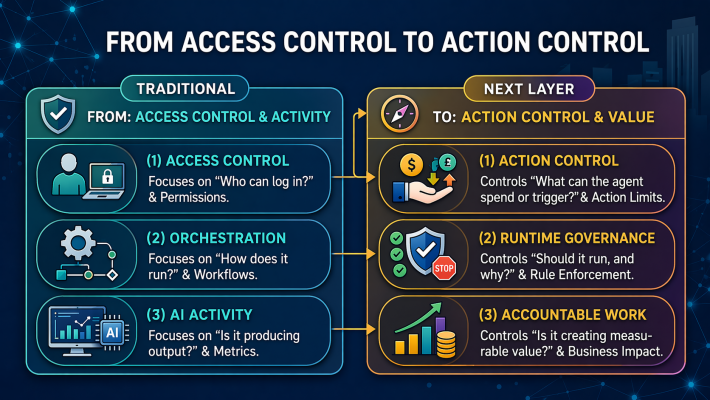
The Architecture Reset is no longer just about moving from UI to headless. It is about a fundamental move in three directions:
From Access Control (Who can log in?) → To Action Control (What can the agent spend or trigger?)
From Orchestration (How does it run?) → To Runtime Governance (Should it run, and why?)
From AI Activity (Is it producing output?) → To Accountable Work (Is it creating measurable value?).
My sense is that the next phase of Enterprise AI adoption will depend not just on making agents operable, but on making their work measurable, governable, and economically legible — before the regulatory clock runs out and the vendor lock-in becomes structural.
The enterprises that define their runtime requirements now will set the terms. The ones that don't will inherit someone else's architecture.