

The real issue is not which model wins today. It is whether enterprise applications are architected to adapt when the answer changes tomorrow. Most teams still build tightly around a single frontier-model API or static fine-tune. But models are evolving too quickly in capability, cost, latency, deployment options, and safety behavior for that architecture to remain durable.
Models are becoming ephemeral execution engines—selected, routed, upgraded, and replaced based on the requirements of each workload.
The next enterprise AI advantage will not come from repeatedly choosing the “best” model. It will come from a Decoupled Enterprise AI Architecture that can govern, route, and economically optimize execution without forcing teams to rewrite applications.
1API Portability Is Not Behavioral Portability
Using the same request format across providers does not make models interchangeable. Models behind identical interfaces can still differ materially in:
Prompt and safety behavior
Structured output and tool reliability
Context utilization and tokenization
Reasoning quality and failure modes
The goal is not complete interchangeability. It is controlled model substitutability: the ability to qualify, route, upgrade, and retire models without rewriting the application.
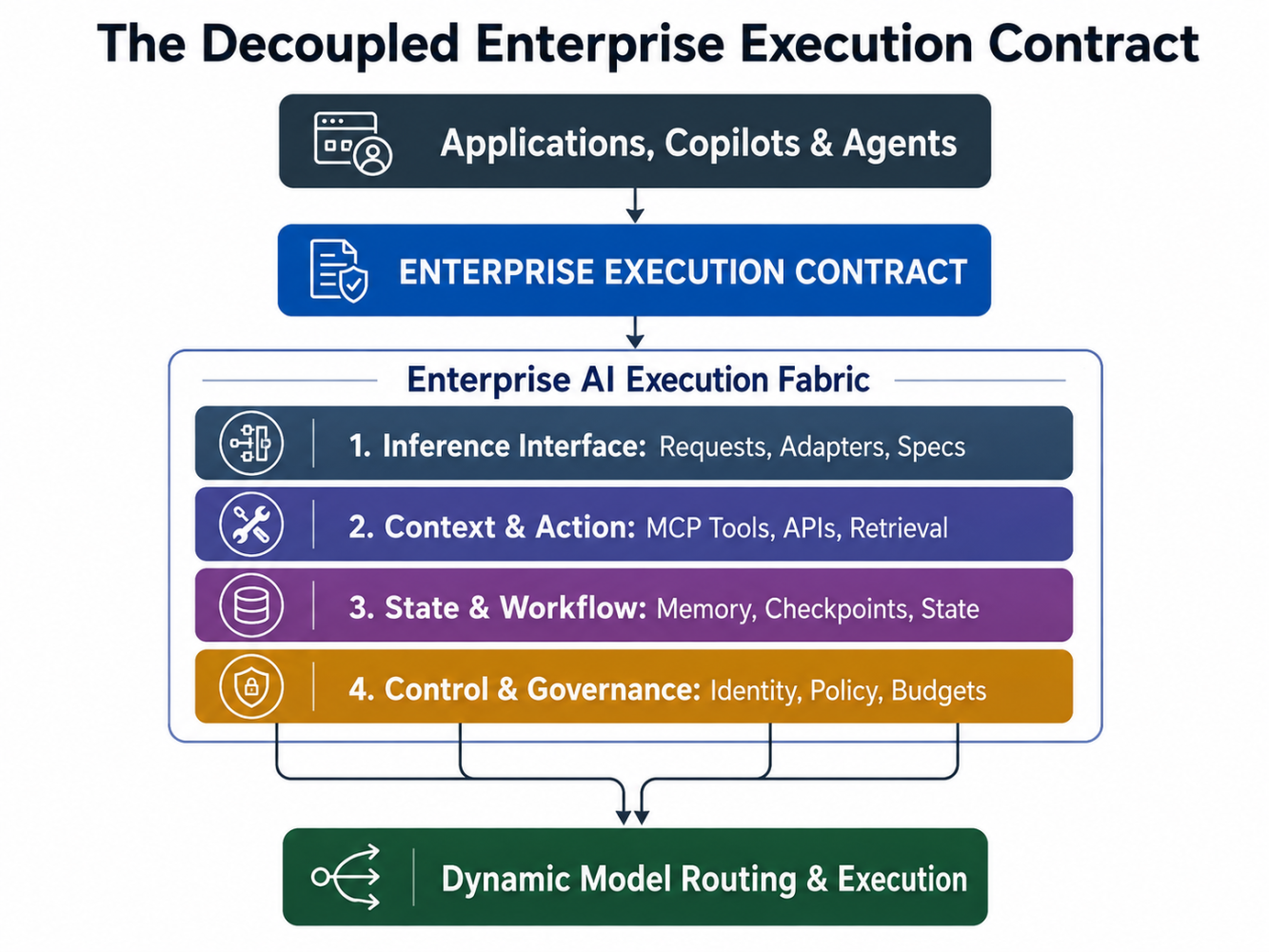
That requires four layers to remain independent from the model itself:
Inference interface — requests, adapters, and structured outputs
Context and action — retrieval, tools, APIs, and MCP
State and workflow — memory, checkpoints, and business state
Control and governance — identity, policy, budgets, audit, and trust boundaries
Together, these form the Enterprise Execution Contract—a stable layer between applications and an increasingly dynamic model ecosystem.
2The Router as the Scheduler for Digital Intelligence
If models are compute engines, the router becomes the scheduler and policy decision point for digital intelligence.
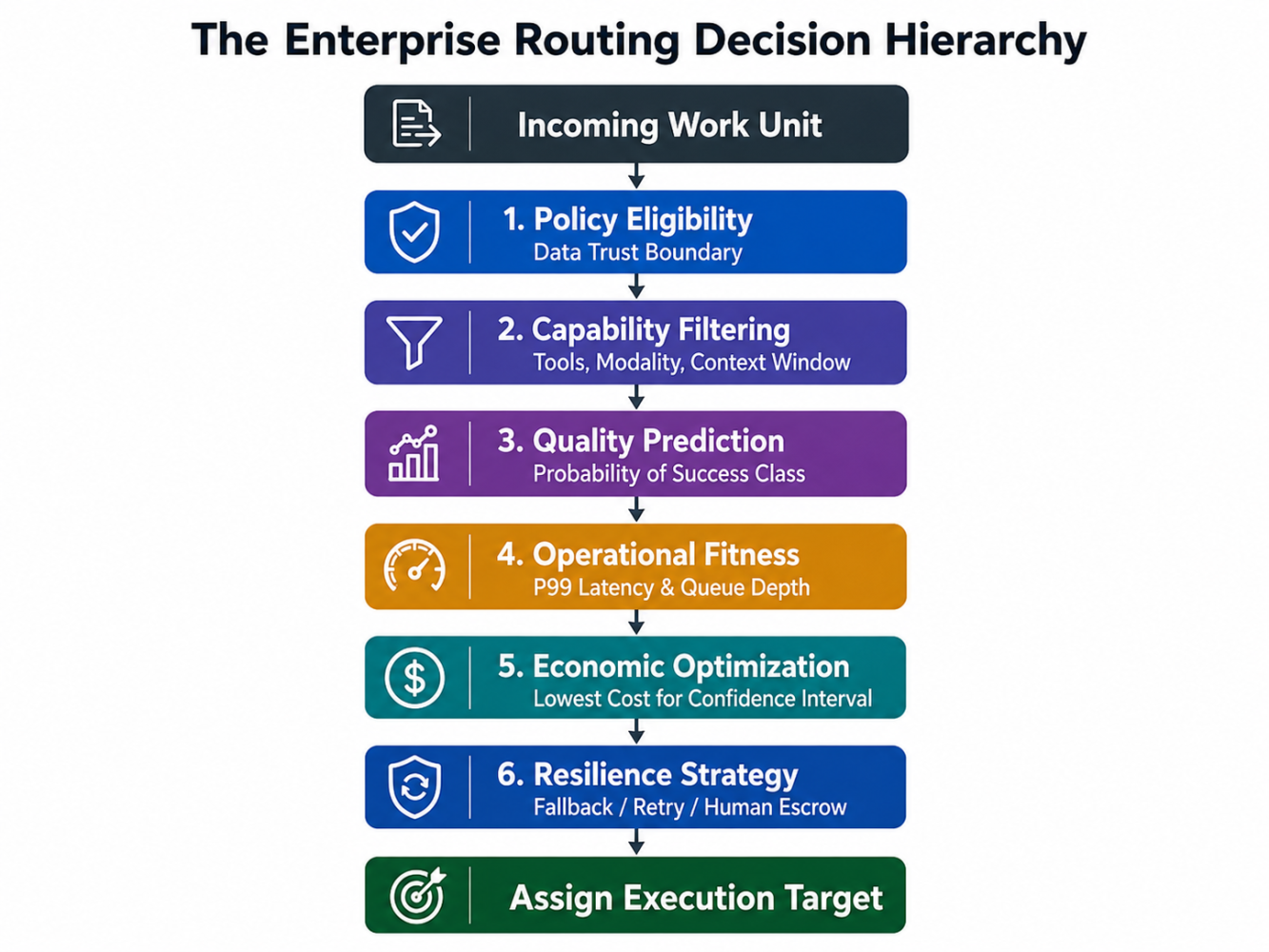
Round-robin balancing and simple prompt-length rules are not enough. Enterprise routing must evaluate every work unit through a strict sequence: the Enterprise Routing Decision Hierarchy.
Policy and capability determine what is permissible. Economics chooses only among the permissible options.
Policy Eligibility — What is permitted?
Capability Filtering — What can perform the work?
Quality Prediction — What is likely to succeed?
Operational Fitness — What is available now?
Economic Optimization — What delivers the required outcome at the lowest expected cost?
Resilience Strategy — What happens if execution fails?
Restricted data must first remain within approved trust boundaries. Models that cannot support the required tools, modality, context, or output schema are then eliminated.
The remaining routes are evaluated against expected quality, current capacity, queue depth, latency, and total execution cost—not merely token price.
Expected Execution Cost = Inference Cost + Expected Failure and Recovery Cost + Latency Penalty + Operational Overhead
Finally, the router defines what happens when execution fails: retry, escalation to a stronger model, deterministic fallback, human review, or termination.
A cheap model that fails frequently can become the most expensive route. A powerful model that is overloaded, prohibited, or unnecessary is equally unsuitable.
Routing is not a gateway feature. It is an enterprise decision engine.
3Open Models Are Not Free
Open-weight models such as Llama, DeepSeek, Qwen, and Mistral are often framed as inherently inexpensive. But low token prices measure model access cost, not the full cost of operating private inference.
Low token cost is not automatically low total cost of ownership.
An underutilized open model running on private GPU infrastructure can cost more than a managed frontier API. A frontier model used for repetitive, bounded work can be equally wasteful.
The better measure is:
Cost per Successful Outcome = Total Execution Cost ÷ Accepted Business Outcomes
Total execution cost includes compute, infrastructure, engineering, idle capacity, security, governance, retries, fallbacks, and failure recovery—not merely token consumption.
Private inference becomes economical only when enterprises can operate it efficiently through:
Efficient serving — batching, cache reuse, and distributed execution
Hardware utilization — autoscaling, scheduling, and accelerator efficiency
Model optimization — quantization, distillation, and workload-specific tuning
A GPU sitting idle between requests—or a model that needs three retries to produce valid output—costs real money whether the weights were free or not.
The real decision is not open versus closed. It is which execution path produces the required outcome at the lowest total cost.
4From Model Routing to Outcome Routing
The end state is not a router that simply selects among models. It is a runtime that selects among execution strategies.
Prompt Routing → Model Routing → Execution Routing → Outcome Optimization
Every request is a work unit carrying business context, policy requirements, quality expectations, and economic value.
The right execution path may be:
Rules, queries, search, or cache
A specialized small model
A private open-weight model
A managed frontier model
An agentic workflow
Human review
The runtime then measures whether that route succeeded using signals such as user acceptance, human correction, tool execution, workflow completion, policy compliance, escalation, and total cost.
Fed back into the routing layer, this evidence gradually replaces static rules with outcome-driven execution decisions.
The most intelligent decision an AI router can make may be deciding not to invoke a large language model at all.
Deterministic work should remain deterministic whenever it is faster, safer, and less expensive.
Where This Gets Real
Most enterprise teams can identify which model processed a request. Far fewer can determine what a successful unit of AI work actually cost.
Once execution is decoupled from a single model, cost, quality, latency, policy, retries, and business outcomes must be measured across every eligible path from day one. Without that feedback loop, a router can distribute traffic—but it cannot determine whether it is creating value.
This is where the architecture becomes an economic operating layer for digital work.
The Durable Architecture
Model selection is no longer a permanent platform decision. Models will continue to improve, specialize, shrink, and commoditize—but they will not become behaviorally identical.
The durable advantage is the architecture around them: the execution contract, policy controls, routing intelligence, and economic feedback loop. The next challenge is turning this into a real-time decision system.
In the next article, I will explore the Smart Enterprise Inference Router—the control point that decides what is permitted to run, where it should execute, which path should handle it, when to fall back, and whether an LLM should be invoked at all.
Models are ephemeral compute. The architecture is the platform.