

For decades, every large enterprise quietly became a software company, building massive technical organizations not because software was their core business, but because running the business meant maintaining enormous software estates. That made sense when code was expensive to build. You paid once and ran it for a decade to justify the spend. Cloud made infrastructure an on-demand utility; the server stopped mattering to the customer. Now AI pushes that abstraction one layer higher.
The fundamental question is no longer which model to deploy, but something far more radical: Why should the enterprise own software implementation at all?
Software as Ephemeral Implementation
As AI systems generate, test, deploy, and modify execution logic dynamically, source code loses its status as a durable asset. A customer support or invoice workflow might run on Python today and agents tomorrow. The enterprise shouldn't care. It should care whether the process ran reliably.
Hardware became ephemeral infrastructure. Models are becoming ephemeral compute. Software may become ephemeral implementation.
From SaaS to Outcome-as-a-Service (OaaS)
SaaS changed where software ran, but not what enterprises bought. Companies still purchased tools like CRMs, ERPs, and ticketing systems, then added internal teams and integration projects to produce results:
Software + People + Integration = Business Outcome Outcome-as-a-Service changes the unit of value being purchased:
Don't sell me customer-support software. Resolve my customer issues.
Don't sell me accounts-payable automation. Validate, approve, pay, and reconcile my invoices.
Don't sell me a logistics platform. Deliver inventory within specified service levels and costs.
This defines the Zero-Stack Enterprise. Zero Stack does not mean zero technology; it means the enterprise stops owning technology implementation as a prerequisite for operating the business.
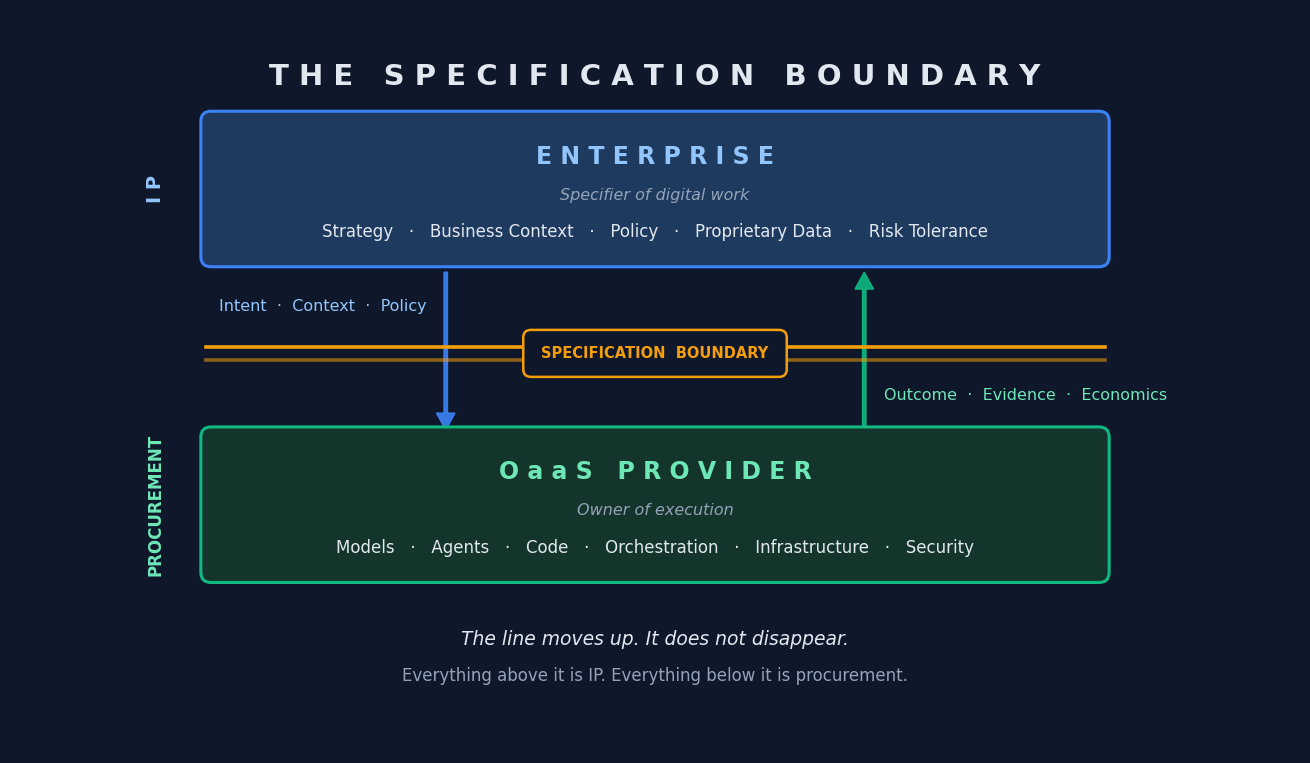
Above the boundary, the enterprise defines what correct looks like; below it, everything is replaceable.
Business IP vs. Implementation IP
Every enterprise leader raises the same objection: "Our software is our intellectual property."
For most non-software firms, the real moat isn't a Java service or React frontend. It is the pricing logic, underwriting rules, twenty years of accumulated exception handling, and specialized operating context. AI increasingly makes it possible to separate Business IP from Implementation IP. Code remains, but its role shifts from something you own to something you regenerate.
This shift will happen fastest in the mid-market. Lacking legacy inertia and internal constituencies defending custom stacks, these firms can bypass much of traditional software ownership to buy guaranteed outcomes directly.
Security Relocation and the Accountability Residue
Offloading implementation relocates security rather than eliminating it. The cloud transition showed that many major failures still originated in customer-side configuration, identity, and access controls rather than the underlying cloud infrastructure. Shared responsibility didn't eliminate risk. It split it.
Under OaaS, much of the technical security moves to the provider: agent isolation, sandboxing, model supply-chain defense, and tool authorization. Specialized teams can invest here much as hyperscalers did with cloud. However, the enterprise retains full ownership of security policy: data boundaries, authorization thresholds, and human-in-the-loop approvals. Security shifts from protecting applications to governing digital work.
Centralization also introduces correlated risk, making provider failover and exit planning essential. One responsibility cannot move:
Execution can be outsourced. Accountability cannot. A regulator or auditor will never accept "the agent did it" as a control framework.
OaaS Is an Outcome Architecture, Not an LLM Architecture
OaaS cannot mean routing every process through a probabilistic model. Financial ledgers, payment executions, and tax calculations demand deterministic precision. Credible OaaS platforms will combine LLMs, smaller models, deterministic code, and human oversight based on the task.
Sometimes, the smartest AI routing decision will be not to use AI at all.
Contextual Lock-In and the Battle for Ownership
The strategic prize in AI is shifting from selling raw tokens toward owning the business outcome. Hyperscalers (compute scale), Frontier AI Labs (intelligence velocity), Incumbents (system-of-record context), and Vertical AI-Natives (bounded workflow execution) are competing for this exact layer.
For AI vendors, the implication is awkward: raw models are rapidly becoming substitutable, which makes model ownership a fragile long-term moat.
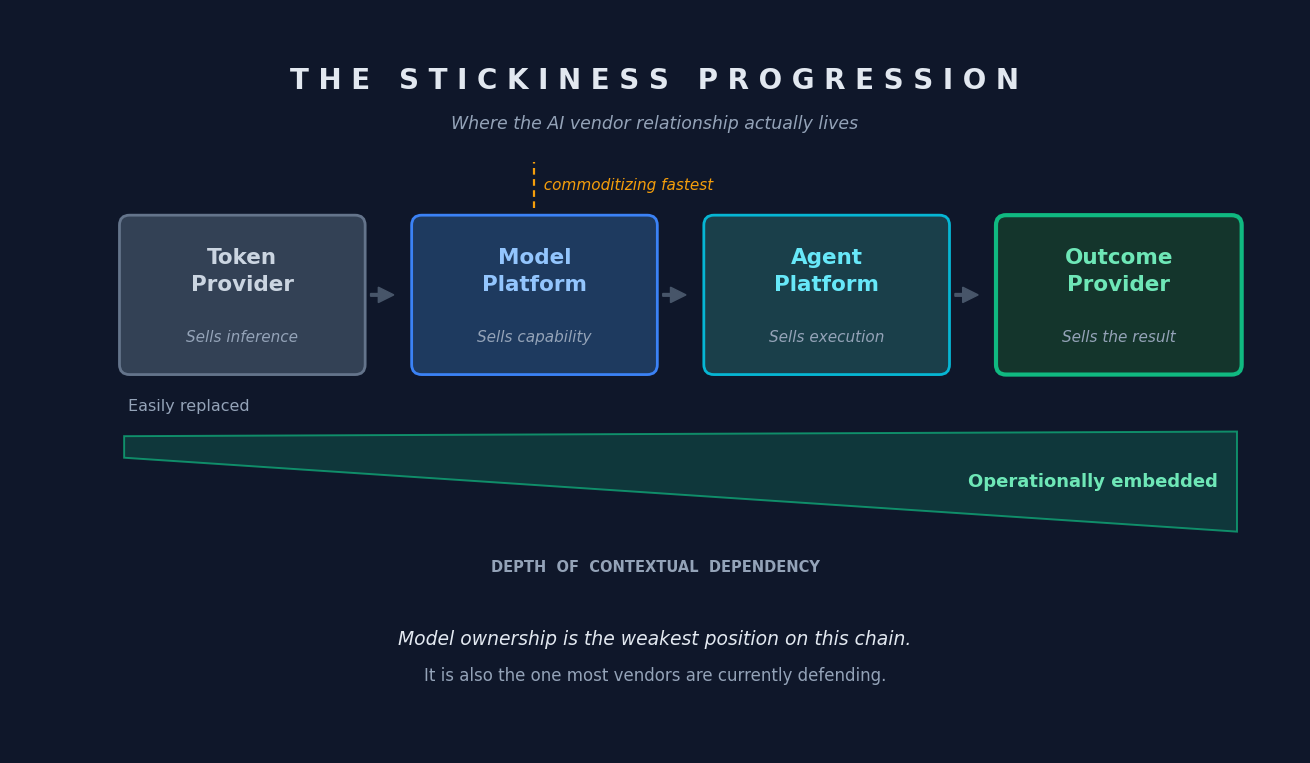
As an OaaS provider runs more of the business, it learns enterprise edge cases, policies, and operating patterns. Over time, it becomes part of the operational nervous system. What makes OaaS attractive for providers is what should make enterprises cautious: the deeper the provider learns the operating context, the harder it is to replace. To prevent contextual lock-in, context portability, policy portability, and independent audit rights must be architected into contracts from day one.
Outcomes Become the Contract
When the enterprise owns the specification and the provider owns execution, per-seat software pricing starts to lose relevance. Outcomes become the core contracting substrate: cost per resolved case, cost per reconciled invoice, or percentage of verified savings.
Because providers cannot grade their own homework, this transition will likely create an independent verification layer to audit digital work, policy compliance, and economic outcomes across vendors.
This evolution elevates the CIO. Enterprise IT moves from a builder and operator of software to an architect, governor, and economic allocator of digital work.
What This Means For You
Enterprise leaders: Know what must remain above the specification boundary before a vendor defines it for you. Most will find it's less than they assumed and worse documented than they feared.
AI vendors: Owning the outcome is the opportunity. Proving it independently will be the requirement.
Founders and investors: Every outcome vendor will build verification internally. None will sell it independently. That layer is still unbuilt.
Cloud asked enterprises: Why own servers if compute can be consumed?
AI asks a far more consequential question: Why own software implementation if business execution can be consumed?
The most technologically advanced organization of the future won't be the company that owns the most software. It will be the one that knows precisely what business context it must govern, and what software implementation it can finally stop owning.